Oral cancer is one of India’s most serious health challenges. While it accounts for about 5% of cancers worldwide, in India it makes up nearly 40% of all cancer cases. Every year, around 60,000 new cases are diagnosed, and tragically, more than five people die every hour due to this disease.
What many people don’t realize is that oral cancer often begins as a small, treatable condition. These early changes in the mouth—called Oral Premalignant Lesions (OPLs)—appear as patches or sores inside the cheek, tongue, or palate. If treated early, these lesions can be removed and cancer can often be prevented.
However, many patients avoid surgery. The reason is not just lack of awareness, but also fear. After removing these lesions, reconstructing the affected area can be complex, requiring advanced surgical techniques, longer recovery times, and sometimes additional procedures from other parts of the body.
A recent clinical study led by Dr. Mandeep Singh Malhotra at C.K. Birla Hospital, New Delhi, offers a promising solution to this problem.
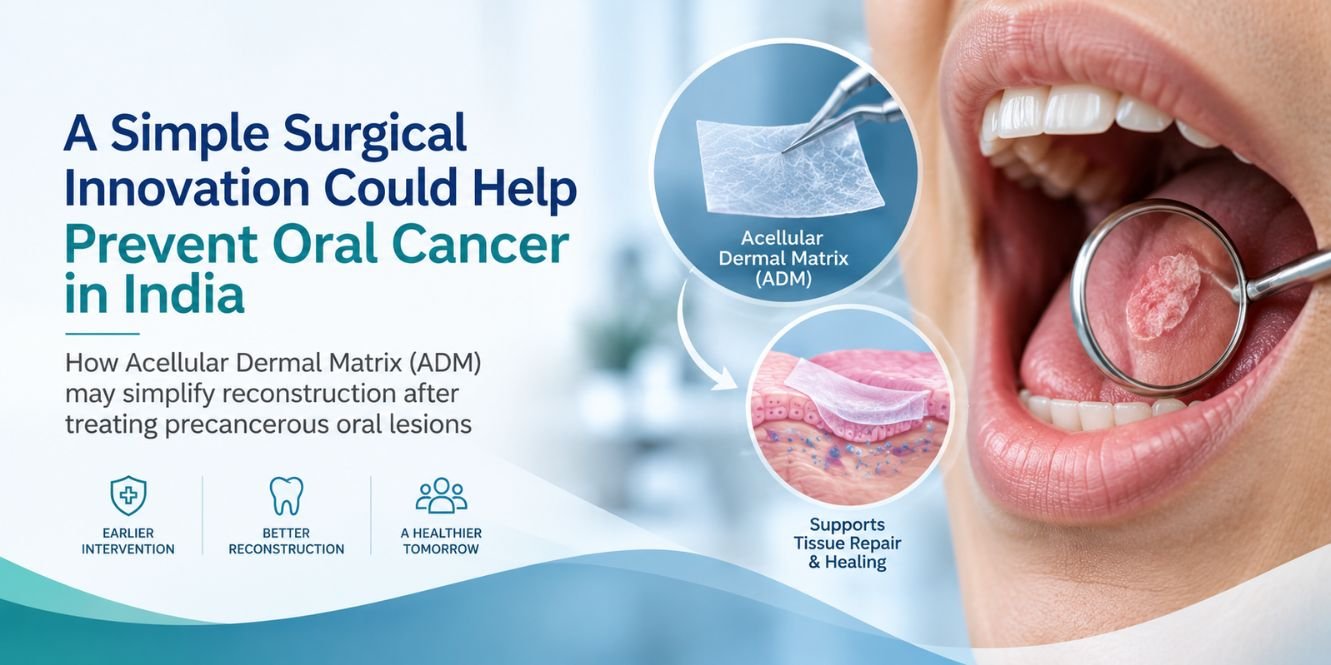
The study explored the use of Acellular Dermal Matrix (ADM), a specially processed biological material, to repair oral tissue after removing precancerous lesions. ADM acts as a natural scaffold that helps the body regenerate its own tissue. Importantly, it eliminates the need to take tissue from another part of the patient’s body.
In this study, seven patients with precancerous oral lesions underwent surgery. After removing the lesion, the resulting defect in the mouth was covered with ADM. The results were encouraging. All patients healed well, with minimal discomfort, no graft rejection, and no recurrence of lesions during the follow-up period.
Why is this important?
Oral premalignant lesions affect around 1.5% to 4.5% of the global population, with higher rates in men. A significant number of oral cancers develop from these lesions. Risk factors include tobacco use, betel nut chewing, smoking, and alcohol consumption—habits that are unfortunately common in India.
Surgical removal of these lesions offers the best chance of preventing cancer. But until now, the complexity of reconstruction has been a major barrier.
ADM could change that.
This technique is simple, effective, and reduces the need for complicated reconstruction procedures. It allows faster healing, less scarring, and avoids additional surgical wounds. Most importantly, it makes early intervention more acceptable to both patients and doctors.
If adopted widely, this approach has the potential to significantly reduce the burden of oral cancer in India by encouraging timely treatment of precancerous conditions.
Early detection, combined with simpler and safer surgical solutions, could save thousands of lives each year.